
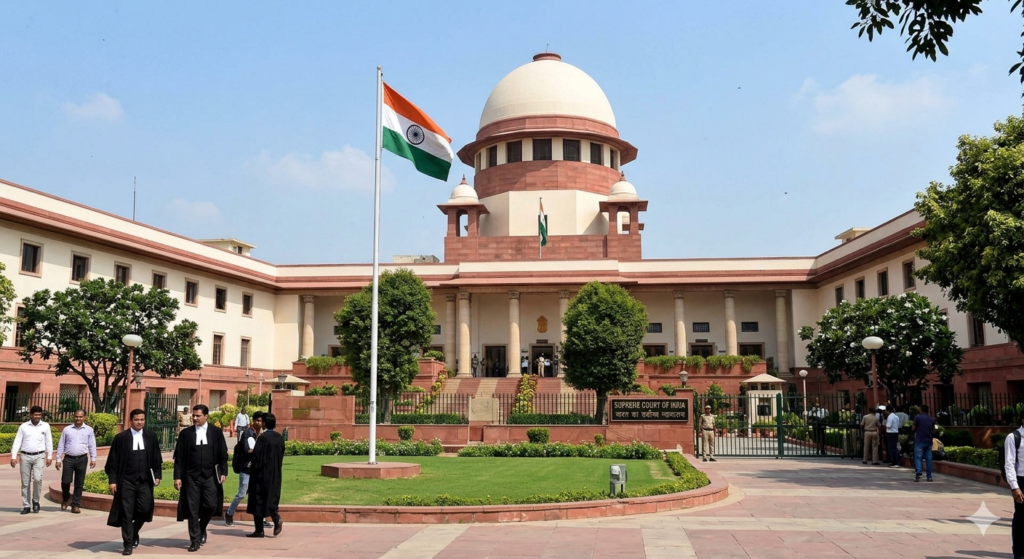
A comprehensive analysis of Manohar Lal v. Commissioner of Police & Ors., where the Supreme Court of India reinforced the strict parameters for bypassing regular disciplinary procedures under the Constitution.
The Supreme Court of India set aside the dismissal of a Delhi Police Constable whose services were terminated without a regular departmental inquiry under Article 311(2)(b) of the Constitution. The Court held that a disciplinary authority cannot dispense with an inquiry based merely on a preliminary report’s presumption that the delinquent officer might intimidate witnesses. Emphasizing the need for objective material, the Court ordered reinstatement with 50% back wages.
Case Details / Citation
- Case Name: Manohar Lal v. Commissioner of Police & Ors.
- Court: In The Supreme Court of India (Civil Appellate Jurisdiction)
- Bench/Judge(s): J.K. Maheshwari, J. and Atul S. Chandurkar, J.
- Case Number: Civil Appeal No. 13860 of 2024
- Citation: 2026 INSC 234
- Date of Judgment: March 12, 2026
Headnotes (Important Legal Principles)
- Service Law – Dismissal without Inquiry – Article 311(2)(b) of the Constitution of India: The Supreme Court ruled that a disciplinary authority cannot dispense with a regular departmental inquiry lightly or arbitrarily. The satisfaction recorded by the authority that holding an inquiry is “not reasonably practicable” must be based on definite and objective material, not merely on the presumption of a preliminary inquiry officer.
- Constitutional Law – Scope of Judicial Review under Article 311(3): The finality given to the decision of the disciplinary authority by Article 311(3) regarding the practicability of holding an inquiry is not binding upon the courts. The court, exercising its power of judicial review under Article 226 or Article 32, can strike down an order of penalty if the reasons for dispensing with the inquiry are found to be irrelevant or an abuse of power.
- Service Law – Delhi Police Act, 1978 and Delhi Police (Punishment and Appeal) Rules, 1980: Dismissal is a major penalty under Rule 6 of the 1980 Rules, which ordinarily mandates a regular departmental inquiry by a competent authority. The power of punishment under Section 21 of the 1978 Act is not absolute and is strictly subject to the provisions of Article 311 of the Constitution and the relevant rules.
- Service Law – Reinstatement and Back Wages: When an order of dismissal passed under Article 311(2)(b) is set aside due to a lack of valid reasons for dispensing with the inquiry, the employee is entitled to reinstatement with continuity of service. However, considering the employee’s involvement in a criminal case, the Court restricted the payment of back wages from the date of dismissal till reinstatement to 50%.
Background of the Case
The appellant, Constable Manohar Lal, was posted in the Special Cell of the Delhi Police. On June 28, 2017, an FIR (No. 390 of 2017) was registered against him and others concerning allegations of robbery and theft of sandalwood. He was subsequently taken into custody on June 29, 2017, and remained incarcerated until he was released on bail on October 14, 2017.
While the appellant was still in custody, the Deputy Commissioner of Police (DCP), New Delhi, passed an order on July 18, 2017, dismissing him from service without conducting a regular departmental inquiry. To bypass the standard procedure outlined in the Delhi Police (Punishment and Appeal) Rules, 1980, the DCP invoked clause (b) of the second proviso to Article 311(2) of the Constitution. The DCP’s reasoning relied heavily on a preliminary inquiry conducted by an Assistant Commissioner of Police (ACP). The ACP concluded that holding a regular inquiry was not “reasonably practicable” because there was a “reasonable belief of threat, intimidation and inducement to the victim” by the appellant and his criminal associates, which could lead to the tampering of vital evidence.
The appellant challenged this dismissal. His appeal was dismissed by the Special Commissioner of Police on July 30, 2018, who accepted the DCP’s reasoning. The appellant then approached the Central Administrative Tribunal (CAT), which dismissed his Original Application on November 29, 2022. The Delhi High Court also declined to interfere, dismissing his Writ Petition on February 2, 2023. Consequently, the appellant approached the Supreme Court.
Legal Issues Before the Court
- Whether the disciplinary authority was justified in invoking clause (b) of the second proviso to Article 311(2) of the Constitution to dismiss the appellant without a regular departmental inquiry.
- Whether the reasons recorded by the disciplinary authority—based on the preliminary inquiry report—constituted sufficient and objective material to demonstrate that holding an inquiry was not “reasonably practicable”.
- Whether the High Court and CAT erred in upholding the dismissal order without thoroughly scrutinizing the validity of the disciplinary authority’s subjective satisfaction.
Arguments of the Parties
Arguments by the Appellant
- Limitation on Punitive Powers: The power of punishment conferred under Section 21 of the Delhi Police Act, 1978 is not absolute and is subject to Article 311 of the Constitution and the 1980 Rules.
- Mandatory Nature of Inquiries: Under Rule 14(2) and Rule 6 of the 1980 Rules, a major penalty like dismissal must be awarded only after a regular departmental inquiry.
- Flimsy Grounds: The reasons assigned for dispensing with the inquiry—specifically the fear of intimidating witnesses—were flimsy, especially considering the appellant was in judicial custody when the dismissal order was passed.
- Misuse of Power: Exercising extraordinary power without convincing material to ignore prescribed procedural rules amounts to a misuse of power by the competent authority.
Arguments by the Respondent (State)
- Egregious Misconduct: Relying on the ACP’s preliminary inquiry, the State argued that the complainant and witnesses could have been traumatized by the egregious acts of the appellant and his associates.
- Threat of Intimidation: Because the appellant had associations with criminals, there was a genuine possibility that he would approach witnesses to induce or intimidate them into withdrawing from the case or turning hostile.
- Valid Exercise of Authority: In light of this apprehension, the DCP acted within his authority to bypass the normal inquiry procedure under the constitutional exception.
- Judicial Concurrence: The State emphasized that both the CAT and the Delhi High Court had accepted the department’s reasoning, and thus no interference by the Supreme Court was warranted.
Court’s Analysis and Reasoning
The Supreme Court engaged in a detailed examination of the constitutional safeguards provided to civil servants. The Court heavily relied on the landmark Constitution Bench judgment in Union of India v. Tulsiram Patel.
Interpretation of “Not Reasonably Practicable”: The Court reiterated that Article 311(2) guarantees a civil servant the right to be informed of charges and given a reasonable opportunity to be heard before dismissal. Clause (b) of the second proviso serves as an exception, applicable only when the disciplinary authority is satisfied that holding such an inquiry is “not reasonably practicable”. The Court emphasized that this means impracticable in the opinion of a reasonable man assessing the prevailing situation, not an absolute impossibility.
Requirement for Objective Material: The core of the Court’s reasoning rested on the necessity of objective material to support the disciplinary authority’s subjective satisfaction. The Court scrutinized the preliminary inquiry report prepared by the ACP. The report contained statements from the complainant and three police officials. Crucially, the Supreme Court found that none of these witnesses stated they had been traumatized, threatened, or intimidated by the appellant.
The Court observed that there was absolutely no material on record to substantiate the claim that the appellant had close associations with criminals that would reasonably lead to witness intimidation. The ACP’s conclusion was deemed a mere “presumption”.
Failure of the Disciplinary Authority: The Court noted that the DCP merely adopted the ACP’s presumption without any independent application of mind or supporting material. Furthermore, the Court highlighted a glaring logical flaw: the dismissal order was passed while the appellant was in judicial custody. The ACP failed to indicate any instances where the appellant had issued threats from inside the jail. Therefore, holding that an inquiry was not reasonably practicable lacked any valid basis.
Critique of the High Court’s Approach: The Supreme Court criticized the Delhi High Court for misapplying precedent. The High Court had justified the dismissal by noting that the appellate authority had given the appellant a hearing. The Supreme Court ruled this reasoning “completely misplaced,” clarifying that the validity of invoking Article 311(2)(b) depends solely on the relevance and objective basis of the reasons recorded for dispensing with the initial inquiry, not on subsequent appellate hearings.
Key Observations of the Court (With Citation)
- On Mere Presumptions: “In absence of any material, in our view, it is merely a presumption of the ACP who conducted the preliminary enquiry and it cannot form the basis of a reasonable apprehension which may be sufficient to dispense with the regular disciplinary inquiry.”
- On the Duty of the Disciplinary Authority: “Analysing the purport of the proviso and the interpretation made in the judgment of Tulsiram Patel (Supra) it was the duty of the disciplinary authority to satisfy himself that such reasoning as indicated in the preliminary enquiry report is based on some material, sufficient to dispense with an enquiry. In absence of the same, merely belief or a presumption is not sufficient to record such finding and to deviate from the normal procedure.”
- On Dismissal While in Custody: “In such a situation it is clear that while he was in custody the order of dismissal was passed. Therefore, it was incumbent upon the ACP holding the preliminary enquiry to indicate any instances of threat from custody to the complainant or to intimidate witnesses brought during investigation.”
- On Arbitrary Action: “Therefore, we can hold that the order dispensing with the regular procedure of inquiry is arbitrary and consequently the order of dismissal of the appellant is liable to be quashed…”
Precedents and Statutes Relied Upon
Statutes Mentioned:
- Constitution of India: Article 311(2) and specifically clause (b) of the second proviso. Governs the constitutional protections afforded to civil servants against arbitrary dismissal.
- Delhi Police Act, 1978: Sections 21 and 22. Deals with the powers and procedures for awarding punishments to police officers.
- Delhi Police (Punishment and Appeal) Rules, 1980: Rules 5, 6, 14, and 16. Classifies major penalties and mandates a regular departmental inquiry for dismissals.
Key Precedents Cited:
- Union of India v. Tulsiram Patel (1985) 3 SCC 398: The foundational Constitution Bench judgment detailing the scope, applicability, and judicial review of Article 311(2)(b).
- Jaswant Singh v. State of Punjab (1991) 1 SCC 362: Relied upon to demonstrate that subjective satisfaction for dispensing with an inquiry must be based on objective facts, not merely the ipse dixit (unsupported assertion) of the authority.
- Tarsem Singh v. State of Punjab (2006) 13 SCC 581: Highlighted that constitutional rights of a delinquent cannot be bypassed lightly or to avoid holding an inquiry.
- Reena Rani v. State of Haryana (2012) 10 SCC 215: Reaffirmed that an order of dismissal is invalid if it fails to disclose concrete reasons why an inquiry is not reasonably practicable.
Final Decision / Holding
The Supreme Court allowed the appeal and passed the following directions:
- Quashing of Orders: The Court set aside the judgments of the Central Administrative Tribunal and the Delhi High Court. It entirely quashed the dismissal order passed by the DCP and confirmed by the appellate authority.
- Reinstatement: The appellant was ordered to be reinstated forthwith with continuity of service.
- Benefits & Wages: He was granted all consequential benefits notionally. However, because of his ongoing involvement in a criminal case, back wages from the date of dismissal until reinstatement were restricted to 50%.
- Liberty to the Department: The Court clarified that this judgment does not preclude the respondent from initiating a regular departmental inquiry against the appellant in accordance with the law.
Expert Legal Commentary
This judgment serves as a critical reaffirmation of the protective framework surrounding public employment in India. Article 311(2)(b) is a powerful tool designed for exceptional circumstances where the machinery of justice would be obstructed by a formal inquiry. However, administrative authorities frequently misuse it as a “shortcut” to terminate employees embroiled in criminal allegations without fulfilling the evidentiary burdens of a departmental proceeding.
The Supreme Court’s strict scrutiny of the ACP’s preliminary inquiry report highlights a vital principle: subjective administrative satisfaction must be anchored in objective reality. By physically calling for and reviewing the preliminary report, the Court exposed the hollow nature of the disciplinary authority’s claims. The judgment clarifies that “possibility” or “presumption” of threat is legally insufficient. Disciplinary authorities must point to specific, demonstrable acts of intimidation, terrorization, or insubordination that render a regular hearing practically impossible.
Furthermore, the judgment places a heavy burden on the State when passing punitive orders against incarcerated employees. If a delinquent is in jail, the logistical barrier to them intimidating witnesses is significantly higher; thus, the State must show how threats were conveyed from behind bars. Moving forward, this case will be a substantial shield for civil servants against summary dismissals based on vague administrative apprehensions.
Key Takeaways
- Article 311(2)(b) is an Exception, Not the Rule: Bypassing a departmental inquiry requires strict adherence to constitutional prerequisites.
- Objective Evidence is Mandatory: Dismissing an employee due to “fear of witness intimidation” requires actual evidence or statements of threat, not mere presumptions.
- Custody Negates Imminent Threat Assumptions: If an employee is in judicial custody, authorities must specifically prove how they are threatening witnesses from jail.
- No Delegation of Satisfaction: The Disciplinary Authority must apply its own mind to the material on record rather than blindly adopting a preliminary inquiry officer’s assumptions.
- Robust Judicial Review: Courts have the power to pierce the veil of administrative “satisfaction” to check if the reasons provided are germane or extraneous.
- Appellate Hearing Cannot Cure Initial Defect: Providing a hearing at the appellate stage does not legitimize a dismissal that unlawfully bypassed the initial departmental inquiry.
Conclusion
In Manohar Lal v. Commissioner of Police, the Supreme Court has unequivocally stated that the fundamental rights of civil servants cannot be casually circumvented using the extraordinary powers under Article 311(2)(b). By demanding objective proof over administrative paranoia, the Court has strengthened the doctrine of natural justice, ensuring that the livelihood of public servants is not stripped away without due process unless definitively necessary.