
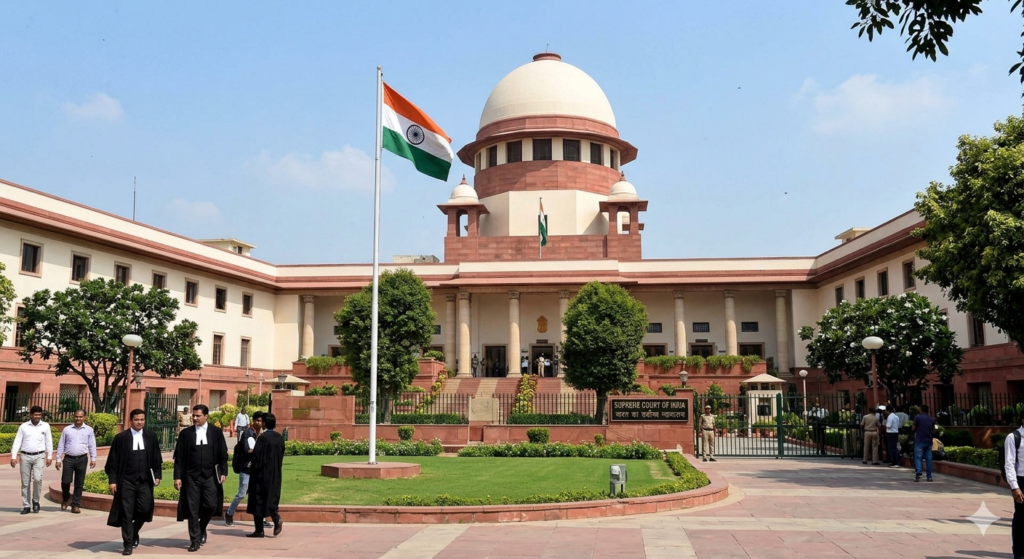
The Supreme Court of India directed the Comptroller and Auditor General (CAG) and the Staff Selection Commission (SSC) to appoint two Persons with Benchmark Disabilities (PwBD) to the post of ‘Auditor’. The candidates were initially rejected on the ground that the post was unsuitable for their specific disabilities. However, relying on a 2021 Government Notification that updated the suitability list, the Court ordered their appointment, further directing the creation of supernumerary posts if the original vacancies had already been filled.
– Case Details / Citation
- Case Name: Sudhanshu Kardam v. Comptroller and Auditor General of India and Ors.
- Court: In The Supreme Court of India (Civil Appellate Jurisdiction)
- Bench/Judge(s): Justice Vikram Nath and Justice Sandeep Mehta
- Case Number: Civil Appeal No(s). OF 2026 (Arising out of SLP (Civil) No(s). (Diary No. 43728/2025))
- Citation: 2026 INSC 232
- Date of Judgment: March 12, 2026
– Headnotes (Important Legal Principles)
- Service Law – Rights of Persons with Disabilities Act, 2016 – Identification of Posts: The Court facilitated the appointment of PwBD candidates suffering from Mental Illness and Specific Learning Disability (SLD) to the post of ‘Auditor’ based on the revised notification dated January 4, 2021, issued by the Ministry of Social Justice and Empowerment, which identified these posts as suitable for the said disabilities.
- Service Law – Creation of Supernumerary Posts: Where PwBD candidates are wrongfully denied appointment or where their rightful allocation is delayed due to administrative reassessments of post suitability, the State must accommodate them; if the original vacancies advertised are already filled, the employer is obligated to create supernumerary posts to ensure their appointment.
- Administrative Law – Inter-Departmental Coordination for Appointments: The Court held that the appointing authority (CAG) cannot deny an appointment merely due to the absence of the candidate’s dossier from the recruiting agency (SSC), and issued a time-bound mandamus to the recruiting agency to forward the required recommendations to effectuate the appointment.
– Background of the Case
In 2018, the Staff Selection Commission (SSC) initiated the Combined Graduate Level Examination (CGLE-2018) to fill various Group ‘B’ and Group ‘C’ posts across Central Government Ministries and Departments. The tentative vacancies included two spots for the post of ‘Auditor’ in the office of the Comptroller and Auditor General of India (CAG) reserved under the ‘Other PwD’ category.
Respondent No. 3, Shri Amit Yadav, applied for this post under the ‘Persons with Disabilities – Other’ and Other Backward Class categories. He possessed a valid certificate indicating 55% disability due to ‘mental illness’. After successfully clearing all tiers (Tier-I to Tier-IV) of the examination, he was recommended for the ‘Auditor’ post. However, in September 2021, the CAG returned his dossier to the SSC, stating that the post of ‘Auditor’ was not identified as suitable for candidates suffering from ‘mental illness’.
Aggrieved, Shri Amit Yadav approached the Central Administrative Tribunal (CAT), relying on a Gazette Notification dated January 4, 2021, which explicitly included ‘mental illness’ as suitable for the Auditor post. The CAT ruled in his favor, directing the CAG to constitute a Medical Board and offer him the appointment if found fit. The CAG challenged this before the Delhi High Court, which set aside the CAT’s order, effectively restoring the rejection of the dossier.
Meanwhile, the Appellant, Sudhanshu Kardam, a similarly situated PwD candidate suffering from Specific Learning Disability (SLD) assessed at over 40%, had also faced rejection and had a pending application before the CAT. Fearing the High Court’s adverse ruling would impact his case, he intervened in the High Court proceedings and subsequently approached the Supreme Court.
– Legal Issues Before the Court
- Whether candidates suffering from ‘Mental Illness’ and ‘Specific Learning Disability’ are eligible for appointment to the post of ‘Auditor’ under the SSC CGLE-2018 recruitment process.
- Whether the updated Gazette Notification dated January 4, 2021, which recognized these disabilities as suitable for the post, should be applied to accommodate the selected candidates.
- What relief should be granted to successful PwBD candidates if the originally advertised vacancies for the recruitment year have already been filled during the pendency of the litigation.
-Arguments of the Parties
Arguments by the Appellant/Respondent No. 3 (PwBD Candidates):
- The candidates successfully cleared all stages of the rigorous SSC CGLE-2018.
- The rejection of their dossiers was arbitrary and contrary to the mandate of the Rights of Persons with Disabilities Act, 2016.
- The Ministry of Social Justice and Empowerment’s Gazette Notification dated January 4, 2021, explicitly identified the post of ‘Auditor’ as suitable for benchmark disabilities including mental illness and specific learning disabilities.
Arguments by the Respondent (CAG/SSC):
- Initially, the CAG argued that during the 2018 identification process, the posts of Assistant Accounts Officer, Divisional Accountant, and Auditor were not identified as suitable for candidates with SLD or Mental Illness.
- Consequently, their dossiers were returned, and the SSC even issued a revised result in November 2022 canceling their allocation.
- However, during the Supreme Court proceedings, the Additional Solicitor General conceded that pursuant to the January 4, 2021 Notification, Group C posts of Assistant (Audit) and Auditor-II were indeed identified as suitable for these benchmark disabilities.
- The CAG expressed willingness to accommodate the candidates but stated it required the official recommendation and dossiers to be forwarded by the SSC to legally make the appointments.
-Court’s Analysis and Reasoning
The Supreme Court adopted a pragmatic and rights-affirming approach, heavily relying on the concessions made by the Respondent (CAG) in its additional affidavit. The Court noted that the Ministry of Social Justice and Empowerment had issued a comprehensive notification on January 4, 2021, under Sections 33 and 34 of the RPwD Act, 2016, which reviewed and expanded the list of Central Government posts identified as suitable for Persons with Disabilities.
The Court observed the CAG’s admission that there was a “change in the rule position” and that the Group C posts of Assistant (Audit) and Auditor-II were now deemed suitable for persons with special and mental illness disabilities. Based on this affidavit, the Court concluded that there was absolutely no remaining impediment to accommodating both the Appellant and Respondent No. 3 in their respective categories.
To resolve the administrative bottleneck where the CAG required the SSC to formally send the dossiers, the Court utilized its powers to issue direct, time-bound instructions to both administrative bodies. Recognizing that the recruitment process pertained to the year 2018 and the vacancies might no longer exist, the Court proactively safeguarded the candidates’ rights by invoking the equitable remedy of directing the creation of supernumerary posts.
– Key Observations of the Court (With Citation)
- On Resolving the Administrative Bottleneck: “The only reservation expressed in the affidavit is that these appointments can be considered only after the recommendation from respondent No.2 – the Staff Selection Commission (SSC) and receipt of the dossiers of the candidates… The respondent No.2-SSC is directed to forthwith and not later than within a period of two weeks from today, forward the dossiers of the appellant herein, as well as R3 – Shri Amit Yadav to respondent No.1-CAG.”
- On Accommodating the Candidates: “Upon the dossiers being received, the appellant herein and R3 Shri Amit Yadav shall be duly considered for appointment against Group ‘C’ posts in terms of the additional affidavit dated 16th February, 2026.”
- On the Creation of Supernumerary Posts: “In case the posts advertised vide notification dated 5th May, 2018 have already been filled, the respondents shall create supernumerary posts for accommodating both these candidates.”
– Precedents and Statutes Relied Upon
- Rights of Persons with Disabilities Act, 2016 (RPwD Act): Specifically, Sections 33 and 34, which mandate the appropriate Government to constitute expert committees to identify posts suitable for persons with benchmark disabilities and ensure reservations.
- Gazette Notification No. 38-16/2020-DD-III (dated January 4, 2021): Issued by the Ministry of Social Justice and Empowerment, this notification updated the list of Central Government Group A, B, C, and D posts suitable for PwBD, including new categories like autism, intellectual disabilities, specific learning disability, and mental illness.
– Final Decision / Holding
The Supreme Court disposed of the appeal with the following categorical directions:
- The Staff Selection Commission (SSC) must forward the dossiers of the Appellant and Respondent No. 3 to the CAG within two weeks.
- Upon receiving the dossiers, the CAG must consider and appoint both candidates against suitable Group ‘C’ posts.
- If the originally advertised vacancies from 2018 are already filled, the respondents must create supernumerary posts to accommodate the candidates.
- The appointments shall take effect from the date of the candidates’ joining.
– Expert Legal Commentary
This judgment is a significant victory for disability rights jurisprudence in India. It bridges the gap between the legislative intent of the RPwD Act, 2016, and the ground-level administrative delays in implementing updated suitability lists. Often, PwBD candidates are caught in a bureaucratic limbo where a recruiting agency (like the SSC) selects them, but the user department (like the CAG) rejects them based on outdated medical criteria.
By holding the State to its updated 2021 Notification—which progressively included ‘Mental Illness’ and ‘Specific Learning Disability’ for Auditor posts—the Supreme Court ensured that the beneficial provisions of the RPwD Act are applied retrospectively to ongoing recruitment disputes. Furthermore, the Court’s directive to create “supernumerary posts” is a crucial equitable remedy. It ensures that candidates who litigate for years to secure their rightful appointments are not turned away at the final hurdle merely because the State filled the vacancies during the pendency of the dispute. This establishes a strong precedent obligating the State to absorb wrongfully denied PwBD candidates, regardless of current vacancy constraints.
– Key Takeaways
- Candidates with Mental Illness and Specific Learning Disabilities are eligible for Group ‘C’ Auditor posts under the Central Government.
- The updated disability suitability lists notified by the Ministry of Social Justice and Empowerment must be applied to resolve pending appointment disputes.
- Recruiting agencies (SSC) and user departments (CAG) must act in tandem; one cannot use the other’s procedural delay to deny a rightful appointment.
- If reserved vacancies are exhausted while a candidate’s rightful claim is pending in court, the Government is bound to create supernumerary posts to accommodate them.
- The effective date of such appointments, however, will be prospective, taking effect from the date of joining.
– Conclusion
The Supreme Court’s decision in Sudhanshu Kardam v. CAG reinforces the constitutional imperative to provide equal opportunity to Persons with Disabilities. By cutting through administrative red tape and directing the creation of supernumerary posts, the Court not only secured justice for the specific candidates involved but also laid down a robust framework preventing the State from using administrative technicalities or lack of vacancies to defeat the rights of PwBD candidates.