
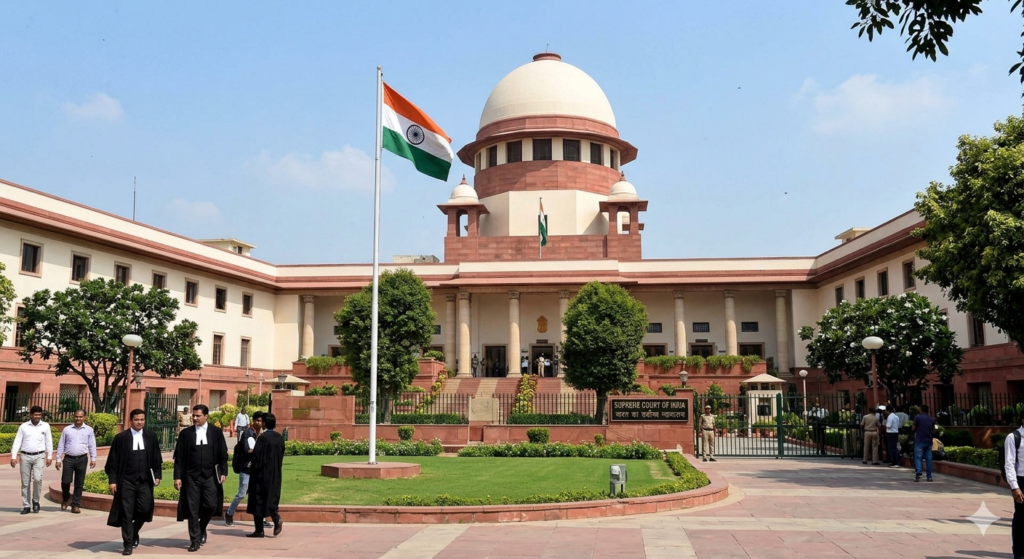
The Supreme Court of India modified an order of the National Company Law Appellate Tribunal (NCLAT) that had limited interim protection to merely one month in a high-stakes corporate dispute over a Rs 1,000-crore slum redevelopment project in Mumbai. Recognizing the imminent threat of asset alienation, the Court directed the parties to maintain a strict status quo until the National Company Law Tribunal (NCLT) finally adjudicates the underlying Oppression and Mismanagement (O&M) petition, mandating a time-bound disposal within two months.
3. Case Details / Citation
- Case Name: Moniveda Consultants LLP and Another v. Shajas Developers Private Limited and Others
- Court: In the Supreme Court of India (Civil Appellate Jurisdiction)
- Bench/Judge(s): Justice Dipankar Datta and Justice Augustine George Masih
- Case Number: Civil Appeal Nos. 9052-9053 of 2022 (With Contempt Petition (C) Nos. 616-617 of 2023 and Contempt Petition (C) Nos. 641-642 of 2025)
- Citation: 2026 INSC 226
- Date of Judgment: March 11, 2026
4. Headnotes (Important Legal Principles)
- Company Law – Oppression and Mismanagement – Interim Relief – Sections 241 and 242(4) of the Companies Act, 2013: The Court held that at an interlocutory stage in a petition alleging oppression and mismanagement, the paramount consideration is to ensure that the subject matter of the proceedings (the company’s primary assets) is preserved until the competent statutory forum adjudicates the dispute.
- Civil Procedure – Injunctions and Status Quo – Preservation of Substratum: Where allegations involve the fabrication of statutory filings to alter shareholding and the imminent stripping of corporate assets worth substantial amounts, interim protection must be co-terminus with the disposal of the main petition rather than being restricted to an arbitrary short timeframe.
- Company Law – NCLT Jurisdiction – Time-Bound Adjudication: The Supreme Court exercised its powers to direct the NCLT, Mumbai Bench, to expeditiously decide the pending Company Petition within a strict timeframe of two months, ensuring that interim protective orders do not indefinitely stall corporate operations.
5. Background of the Case
The appellants, Moniveda Consultants LLP (formerly Gauri Rajeshwari Consultants Pvt. Ltd.) and its partner (Appellant No. 2), claimed to hold a 40% equity stake in Respondent No. 1, Shajas Developers Private Limited. Respondent No. 1 is the holding company that owns 100% of the share capital of Respondent No. 2, JLS Realty Private Limited. Respondent No. 2 is engaged in the lucrative business of slum redevelopment, possessing land admeasuring approximately 21,727 square meters in Jogeshwari (East), Mumbai, with attendant development rights valued at roughly Rs. 1,000 crores.
The project initially included an Israeli entity, the Levinstein Group, as a strategic joint venture partner holding a 64.08% stake. The project faced severe financial and operational distress between 2013 and 2016, with borrowings from IIFL Finance Limited reaching approximately Rs. 275 crores. In May 2016, the Levinstein Group exited by selling its stake to Respondent No. 1, making Respondent No. 2 a wholly-owned subsidiary. Concurrently, Appellant No. 1 entered into an agreement to acquire the entire shareholding of Respondent No. 1 and took over the liabilities of Respondent No. 2.
According to the appellants, they infused approximately Rs. 55 crores into the project, cleared encumbrances, and repaid the IIFL loan. However, in early 2021, the appellants discovered that a revised statutory form (MGT-7) had been backdated and filed with the Registrar of Companies (RoC), illegally removing their 40% shareholding. Furthermore, forms were filed attempting to illegally alter the board of directors (DIR-12) without proper notice or valid board meetings.
The appellants alleged that this corporate hijacking was masterminded by Respondent No. 3 (a personal guarantor facing acute financial distress) to strip the company’s assets. They filed Company Petition No. 159(MB) of 2021 before the NCLT Mumbai under Sections 241, 242, 244, and 59 of the Companies Act, 2013. In July 2021, the NCLT refused to grant interim relief. During the subsequent appeal to the NCLAT, Respondent No. 2 allegedly executed a conveyance deed transferring the project land to a third party (Spenta Suncity Pvt. Ltd.) and mortgaged it for a Rs. 525 crore loan.
The NCLAT eventually remanded the matter back to the NCLT but restricted its interim protection (a restraint against taking “perceptive steps”) to a mere one-month period. Aggrieved by this heavily limited protection, the appellants approached the Supreme Court.
6. Legal Issues Before the Court
The Supreme Court primarily considered the following interlocutory legal issues:
- Whether the NCLAT erred in restricting interim protection to a maximum period of one month despite grave allegations of ongoing asset stripping and illegal alteration of shareholding during the pendency of a Section 241/242 petition.
- What is the appropriate scope and duration of interim protection required to preserve the substratum of a company (the subject matter of the dispute) until the NCLT finally adjudicates a claim of oppression and mismanagement.
7. Arguments of the Parties
Arguments by the Appellants (Moniveda Consultants LLP & Anr.):
- Imminent Threat of Shell Creation: The appellants argued that unless a strict status quo ante is restored and meaningful, continuous interim protection is granted, Respondent Nos. 1 and 2 would be systematically stripped of all their valuable assets and reduced to mere shell companies by the time the NCLT decides the main petition.
- Corporate Hijacking: They contended that the respondents blatantly fabricated statutory filings (MGT-7 and DIR-12) to unlawfully oust them from the shareholding and directorship, despite their massive financial infusions that revived the distressed slum rehabilitation project.
- Contemptuous Conduct: The appellants further alleged (via contempt petitions) that the respondents had continuously violated the interim restraint orders previously issued by the Supreme Court by undertaking construction activities, registering the project with regulatory bodies, and marketing units to prospective buyers.
Arguments by the Respondents (Shajas Developers Pvt. Ltd. & Ors.):
- Denial of Allegations: The respondents fundamentally disputed the allegations of corporate hijacking and asset stripping.
- Rebuttal of Contempt: In response to the contempt petitions, the respondents controverted the claims that they had willfully disobeyed the Supreme Court’s interim directions or illegally alienated the property, asserting that the allegations required deeper factual determination by the trial forum.
8. Court’s Analysis and Reasoning
The Supreme Court’s analysis was sharply focused on the principles governing interlocutory equitable relief rather than rendering a final verdict on the complex factual disputes.
Preservation of the Subject Matter:
The Court noted that the present appeals arose entirely at an interlocutory stage while the substantive Company Petition containing severe allegations of oppression, mismanagement, and fabrication of records remained pending before the NCLT. The Court reasoned that the 21,727 square meters of prime real estate in Mumbai constituted the absolute “principal asset” connected with the dispute. If third-party rights were allowed to be created or the property alienated during the litigation, the final judgment of the NCLT would be rendered entirely infructuous.
Review of Prior Interlocutory Protective Measures:
The Court reflected on its own prior orders to highlight the necessity of continuous protection. It noted that in December 2022, it had to extend the NCLAT’s restraint against “perceptive steps” to prevent immediate harm. Furthermore, when Spenta Suncity Pvt. Ltd. (the entity to which the land was allegedly conveyed) was dragged into the Corporate Insolvency Resolution Process (CIRP) under Section 7 of the Insolvency and Bankruptcy Code (IBC) in July 2024, the Supreme Court had to issue an urgent halt on all construction activities to freeze the asset’s status. The Court had only permitted extremely limited, highly regulated “protective works” (like barricading and laying foundations in excavated pits) strictly to prevent structural collapses of neighboring buildings, explicitly clarifying that this created no equity for the respondents.
Conclusion on NCLAT’s One-Month Restriction:
Given this highly volatile factual matrix—including the IBC proceedings against the third-party purchaser and the serious allegations of digital forgery in RoC filings—the Supreme Court concluded that the NCLAT’s decision to limit interim protection to merely one month was legally insufficient and practically dangerous. The Court held that the paramount consideration must be the preservation of the project land until the competent forum officially adjudicates the underlying corporate war.
9. Key Observations of the Court (With Citation)
- On the Necessity of Interim Relief: “In such circumstances, the paramount consideration is to ensure that the subject matter of the proceedings is preserved until the competent forum adjudicates the dispute.” (Para 27)
- On Extending the Protection: “Having regard to the sequence of orders passed by this Court and the limited nature of the dispute presently before us, we are of the considered view that the interim arrangement which has been operating pursuant to the earlier orders of this Court ought to continue until the competent forum finally adjudicates the underlying controversy.” (Para 28)
- On the Directions to Parties: “Accordingly, it is directed that the parties shall maintain status quo in terms of the earlier orders passed by this Court, and no steps shall be taken which would alter the nature of the property or create further third-party interests therein.” (Para 29)
- On Expediting the Trial: “The Company Petition No.159(MB) of 2021, in particular, shall preferably be decided within a period of two months from the date of appearance of the parties.” (Para 30)
10. Precedents and Statutes Relied Upon
While the Supreme Court order was brief and focused heavily on the factual necessity of an injunction, it operated firmly within the framework of the following statutes:
- Companies Act, 2013 – Sections 241 and 242: These sections deal with relief in cases of oppression and mismanagement. Section 242(4) specifically empowers the Tribunal to make any interim order it thinks fit for regulating the conduct of the company’s affairs during the pendency of the proceedings. The Supreme Court’s order implicitly enforces the spirit of Section 242(4) by ensuring the asset is not dissipated.
- Companies Act, 2013 – Section 59: Pertains to the rectification of the register of members, invoked by the appellants regarding their allegedly illegal removal from the shareholding via the backdated MGT-7.
- Insolvency and Bankruptcy Code, 2016 – Section 7: Mentioned in the context of the corporate insolvency resolution process initiated against Spenta Suncity Pvt. Ltd. (Respondent No. 11), complicating the asset matrix and necessitating the Supreme Court’s protective freeze.
11. Final Decision / Holding
The Supreme Court modified the impugned order of the NCLAT dated 11.10.2022. It directed that the interim protection—specifically the mandate to maintain status quo and the restraint against taking any “perceptive steps” to alter the nature of the property or create third-party interests—shall continue to operate seamlessly until the NCLT disposes of the main Company Petition.
Crucially, to balance the equities and prevent the project from languishing indefinitely, the Court directed the NCLT, Mumbai Bench, to proceed with the pending matters expeditiously. The parties were ordered to appear before the NCLT on March 19, 2026, and the Tribunal was directed to preferably decide Company Petition No. 159(MB) of 2021 within a strict period of two months from that date. All pending contempt petitions were disposed of, leaving merits open for the NCLT.
12. Expert Legal Commentary
This judgment is a vital reaffirmation of a fundamental tenet of corporate litigation: the indispensable role of interim injunctions in Oppression and Mismanagement (O&M) suits. When minority shareholders or joint venture partners allege corporate hijacking—especially through the modern, insidious method of fraudulently filing digital forms (MGT-7, DIR-12) on the Ministry of Corporate Affairs (MCA) portal—the judicial system must act swiftly. If courts or tribunals fail to freeze the company’s assets, the controlling faction can easily execute conveyance deeds and heavy mortgages (as seen here with the Rs. 525 crore loan to Spenta Suncity). By the time the NCLT delivers a final verdict on the legality of the board meetings or share transfers, the successful petitioner might only inherit a hollow, debt-ridden shell.
The NCLAT’s previous decision to restrict the interim stay to merely one month was highly impractical given the chronic backlog at the NCLT. The Supreme Court’s intervention to stretch the status quo until the final disposal of the suit ensures that the Rs. 1,000-crore slum rehabilitation asset is shielded from further encumbrance.
Furthermore, the Supreme Court’s proactive mandate setting a hard two-month deadline for the NCLT, Mumbai Bench, to conclude the trial is a welcome move for the real estate sector. Slum rehabilitation projects involve the livelihoods and housing of thousands of vulnerable citizens. Indefinite stays paralyze these projects. By freezing the assets but drastically expediting the trial timeline, the Supreme Court has masterfully balanced the need for corporate justice with commercial and social pragmatism.
13. Key Takeaways
- Interim Relief in O&M is Crucial: Courts must prioritize preserving the company’s substratum and principal assets when severe allegations of asset-stripping and digital forgery of corporate records are presented.
- Arbitrary Time Limits on Stays are Impractical: Restricting a status quo order to a brief period (e.g., one month) in complex corporate litigation is ineffective and exposes the company to irreparable harm.
- Creation of Third-Party Rights Must be Halted: When the underlying shareholding is fiercely disputed, transferring development rights or mortgaging corporate land to third parties (like Spenta Suncity) will inevitably trigger further legal chaos, especially if those third parties enter insolvency (CIRP).
- Supreme Court Directives Override Tribunal Delays: The Supreme Court will utilize its appellate powers to set strict, time-bound deadlines (two months) for NCLT benches to conclude delayed O&M trials, ensuring commercial projects are not indefinitely stalled.
- No Equity in Preventive Measures: Allowing minor protective construction works (like barricading excavated pits to prevent structural collapse) does not create any legal equity or rights for the party currently in possession of the land.
14. Conclusion
The Supreme Court’s order in Moniveda Consultants LLP v. Shajas Developers underscores the judiciary’s protective role during the fragile interlocutory phases of corporate warfare. By enforcing a continuous status quo while simultaneously imposing a stringent two-month deadline on the NCLT for final adjudication, the Court effectively neutralized the threat of asset stripping without condemning the underlying Rs. 1,000-crore real estate project to indefinite judicial limbo. This balanced approach serves as a strong precedent for handling complex oppression and mismanagement disputes involving high-value, illiquid assets.