2. At a Glance (TL;DR Summary)
- Who was involved: A divorced couple locked in a legal battle over the financial maintenance of their son.
- The core dispute: Whether the ex-husband was legally required to continue paying 20% of his annual income indefinitely, or if his multi-crore lump-sum settlement permanently cancelled out that obligation.
- Who won: The Supreme Court ruled in favor of the ex-husband, concluding that all his maintenance obligations legally ended once the agreed-upon lump sum was paid.
3. The Background (The Facts) The husband and wife finalized their divorce by mutual consent in 2015, signing a detailed financial settlement agreement. This agreement contained three critical clauses regarding how the husband would financially support their son.
Clause 8 required the husband to pay a massive total lump sum of Rs. 2.2 Crores in installments by selling his real estate. Clause 9 required him to pay 20% of his annual income toward the son’s maintenance and education. Finally, Clause 10 explicitly stated that once the husband paid the first Rs. 1 Crore of the lump sum, he “need not pay any further amount towards maintenance”.
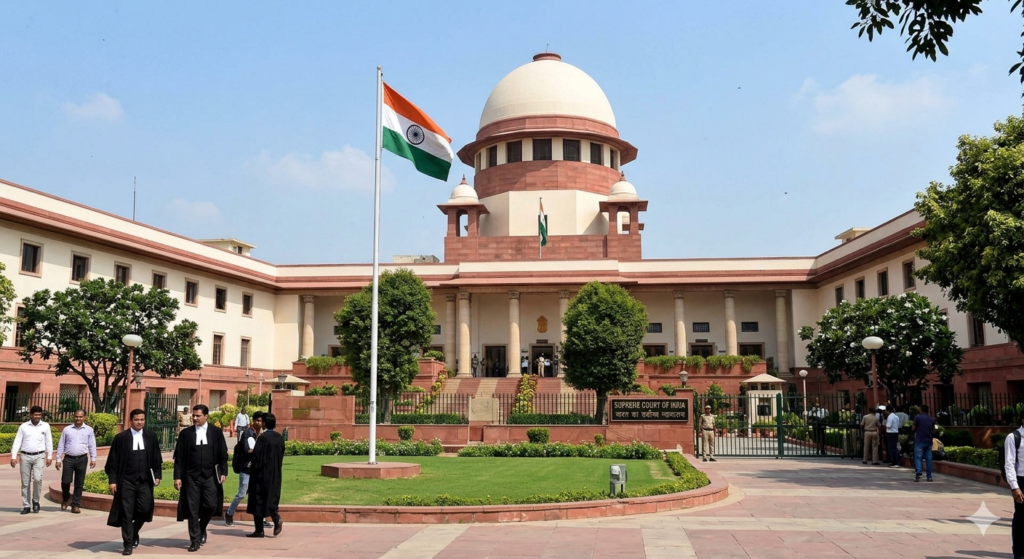
The husband paid the full Rs. 2.2 Crores by July 2017. However, in March 2022, the ex-wife filed a legal petition demanding he also pay 20% of his income retroactively and moving forward. This ignited a legal dispute that worked its way up to the Supreme Court of India.
4. The Core Legal Issue The court had to decide whether the requirement to pay 20% of the husband’s annual income was a permanent, independent obligation, or if it was merely a temporary arrangement that automatically ended once he paid the initial lump-sum amount.
5. The Arguments
- The Appellant (Ex-Wife): She argued that Clause 9 (the 20% income requirement) was a completely independent, ongoing obligation meant to secure their son’s education and welfare. She insisted that treating this clause as cancelled would make the contract’s explicit wording meaningless and redundant.
- The Respondent (Ex-Husband): He argued the three clauses were part of a single, interlocking package. The 20% income payment was just an interim stopgap to support the son while the husband liquidated properties to raise the massive Rs. 2.2 Crore lump sum. He pointed directly to Clause 10, which acted as a termination switch, legally ending all further maintenance once the first Rs. 1 Crore was handed over.
6. The Court’s Reasoning & Analysis (Decoding the Judgment) Reading the Contract as a Whole The Supreme Court ruled that legal contracts must be read as a coherent whole, not by isolating individual sentences. The judges agreed entirely with the husband’s commercial logic: Clause 8 set the final price, Clause 9 offered temporary interim support, and Clause 10 permanently terminated that interim support once the big money started flowing.
General Law vs. Specific Contracts The ex-wife’s legal team cited past precedents (like Kirti Malhotra v. M.K. Malhotra) to argue that a father has a general, ongoing duty to maintain a dependent child. However, the Supreme Court clarified a vital legal principle: when parties are in an “execution proceeding”—meaning they are simply asking the court to enforce a pre-existing settlement—the court cannot rewrite the deal or impose general obligations that contradict what the parties specifically agreed to in writing.
The Power of Silence The judges made a sharp observation regarding the ex-wife’s own behavior. She waited nearly five years after the final lump-sum payment to demand the 20% income cut. The Court noted that in 2015, she had swiftly demanded a pending sum of just Rs. 1,80,000. The judge observed that such an otherwise prompt, legally-advised person would not stay entirely silent for five years if she genuinely believed a massive cut of her ex-husband’s income was still legally owed to her. Her delay proved she originally understood the contract the exact same way the husband did.
7. The Final Verdict The Supreme Court formally dismissed the ex-wife’s appeal, ruling that the ex-husband’s obligation to pay 20% of his income legally ceased the moment he paid the initial Rs. 1 Crore.
However, noting the son’s ambition to study electrical engineering abroad, the Court recorded that the ex-husband had voluntarily deposited an extra Rs. 1 Crore for his son’s education as a gesture of goodwill, officially waiving any right to take it back.
8. Why It Matters (The Impact) This judgment acts as a definitive warning about the sheer power of “discharge clauses” in divorce and corporate settlements alike. It confirms that when a legally binding contract states a party “need not pay any further amount” after a specific milestone, the courts will interpret that discharge literally and absolutely.
Furthermore, it prevents parties from “double-dipping” by attempting to combine temporary maintenance clauses with final, lump-sum capital settlements. Ultimately, it emphasizes that courts will look closely at a person’s delayed actions—or inaction—to figure out how they truly understood a contract when they originally signed it.