
Introduction
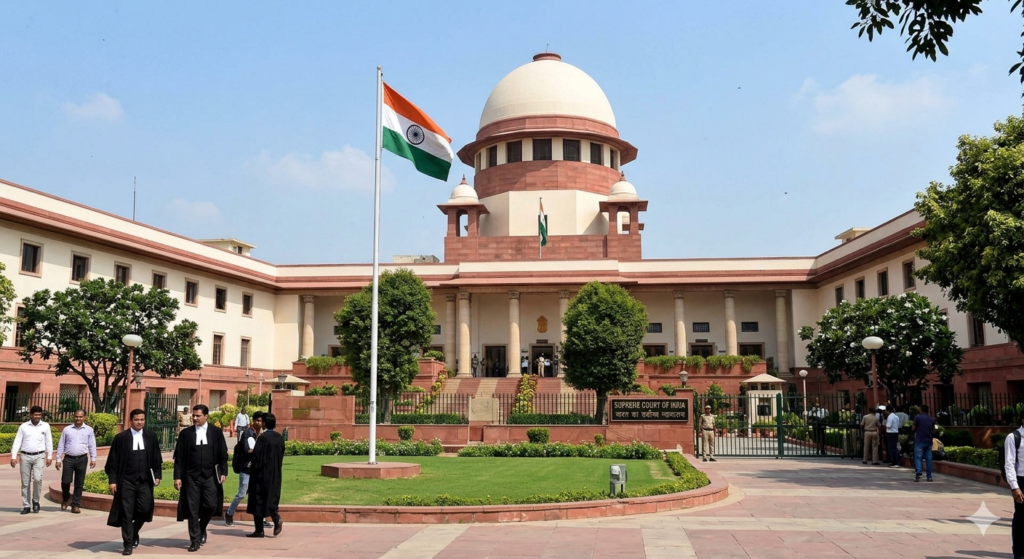
In a stern indictment of administrative apathy and procedural red tape, the Supreme Court of India held that where a major penalty of removal from service is subsequently modified to a minor penalty, the punishment must relate back to the date of initial termination rather than the date of any subsequent illegal order. A Division Bench comprising Justice J.B. Pardiwala and Justice K. Vinod Chandran delivered the ruling in Prakash Kumar Dixit v. Ajay Kumar Bhalla and Ors. (2026 INSC 725 / Civil Appeal No. 9224 of 2026). The apex court severely admonished departmental authorities for sacrificing an officer’s promising career in the Central Reserve Police Force (CRPF) at the “altar of callous indifference” and “brazen pen-pushing” across a quarter-century of litigation. To adjust equities for a career cut short by prolonged administrative inaction, the Court directed the grant of back wages, promotion as Deputy Commandant with retrospective effect, revised retirement and pensionary benefits, and imposed ₹10 Lakhs as costs on the respondents to defray litigation expenses.
Factual Background (The Matrix)
The appellant commenced his service as an Assistant Commandant in the CRPF in 1986. In 1989, departmental proceedings were initiated against him alleging that he handed over charge of a platoon deployed in a sensitive area to an Inspector without approval and remained absent without sanctioned leave for 420 days. The inquiry culminated in an order dated July 10, 1995, removing the appellant from service.
This initiated a 25-year litigation ordeal before the Delhi High Court involving multiple remands. In 2011, a Single Judge set aside the termination order for non-application of mind. In 2012, a Division Bench directed his reinstatement, which was affirmed by the Supreme Court in 2014. However, upon reinstating him in 2015, the Department placed the appellant under “deemed suspension” with effect from July 10, 1995.
Upon fresh consideration, the Disciplinary Authority (D.A.) identified significant mitigating factors—including oral directions from the Commandant and medical certificates—and resolved to impose only a minor penalty of reduction by one stage for three years without cumulative effect and without adversely affecting pension. However, an Under Secretary in the Ministry of Home Affairs (MHA) misinterpreted the advice of the Union Public Service Commission (UPSC) as a “disagreement” with the D.A.. Following inter-departmental references through the Department of Personnel and Training (DoPT) and Ministry of Law and Justice (MLJ), the matter was placed before the Prime Minister under Entry 39(2) of the Third Schedule to the Government of India (Transaction of Business) Rules, 1961, resulting in a second termination order in 2018.
In December 2019, a Division Bench of the Delhi High Court quashed the 2018 termination, holding that the Under Secretary had misconstrued the UPSC advice, and affirmed the minor penalty prescribed by the D.A. with directions that reinstatement and seniority relate back to the 1995 termination. This judgment was affirmed by the Supreme Court in December 2020.
When the department failed to implement the judgment, the appellant filed a contempt petition. During pendency, a review Departmental Promotion Committee (DPC) convened in March 2023 granted him promotion to Deputy Commandant only on a notional basis with effect from October 17, 2021—improperly calculating the 3-year minor penalty rigor from the 2018 second termination date. A Single Judge in contempt proceedings found senior officers guilty and directed the appellant’s promotion to Inspector General (I.G.). On appeal following a remand, the Division Bench held that the appellant could not claim promotion to I.G. without satisfying statutory eligibility criteria. The appellant then approached the Supreme Court.
Core Issues Framed
The Supreme Court considered the following pivotal questions of law and administrative procedure:
- Computation and Relation-Back of Modified Penalty: Whether a minor penalty substituted in place of an illegal termination order relates back to the date of original termination (July 10, 1995) or calculates from the date of a subsequent invalid termination order (October 16, 2018).
- Eligibility vs. Consequential Relief in Contempt: Whether an officer who was kept out of active service due to illegal termination can be granted promotion to higher selection posts (such as I.G.) without fulfilling mandatory statutory eligibility conditions (e.g., mandatory field service and pre-promotional courses).
- Equitable Moulding of Relief: How constitutional courts under Article 136 and Article 226 should adjust equities when an employee’s active service is curtailed by administrative red tape and multi-decadal litigation.
Arguments at a Glance
Submissions on behalf of the Appellant:
- Senior Advocate Mr. Sanjoy Ghosh submitted that the department’s implementation of the High Court’s directions was a complete farce. The minor penalty ought to relate back to the initial termination date of July 10, 1995.
- He argued that reckoning the 3-year penalty period from 2018 was artificially constructed to deny the appellant timely promotions and monetary benefits.
- Even if promotion to I.G. was ineligible, the appellant was entitled to full back wages and actual promotion as Deputy Commandant from the original DPC date when his juniors were promoted, enabling higher pensionary benefits.
Submissions on behalf of the Respondents:
- Additional Solicitor General Mrs. Archana Pathak Dave contended that the disciplinary proceedings were validly initiated and delinquency was established.
- She argued that the rigor of the minor penalty restricted consideration for promotion during the three years following the second termination order in 2018.
- She emphasized that the appellant failed to meet mandatory statutory prerequisites for the post of I.G., including five years residency, two years mandatory field service, and completion of the pre-promotional course.
Court’s Observations & Reasoning (Ratio Decidendi)
1. Minor Penalty Relates Back to Original Date of Removal
Authoring the judgment, Justice K. Vinod Chandran rejected the Union Government’s contention that the 3-year rigor of the minor penalty commenced from October 16, 2018. The Bench held that when the High Court set aside the second termination and restored the D.A.‘s minor penalty, the penalty automatically related back to the initial date of termination.
“When the High Court… directed imposition of a minor penalty as decided by the D.A, it necessarily has to relate back to the date of appellant’s initial termination i.e., 10.07.1995. The rigor of punishment thus, would be over on 10.07.1998 and since the appellant was out of service it does not visit any consequence on him since only notional benefits are given during the said period, the reduction by one stage being non-cumulative and leaves the pension unaffected.”
Consequently, the Court held that when the review DPC convened in March 2023, it erred in granting promotion to Deputy Commandant only notionally from 2021. The promotion had to be granted with all attendant benefits from the date his batchmates/juniors were promoted under the original DPC.
2. Scope of Judicial Review in Service Disciplinary Matters
The Court reaffirmed the foundational principle governing judicial review under Article 226 of the Constitution in departmental inquiries, noting that courts do not sit as courts of appeal over findings of fact unless vitiated by patent arbitrariness or procedural illegality. However, the Bench highlighted that constitutional courts will intervene when administrative authorities act with “callous indifference” to judicial directions.
“It is trite that a judicial review under Article 226, of an order passed in a departmental inquiry holding the delinquent guilty and imposing punishment, is not concerned with the merits of the case and is more on procedure; unless the decision is without authority or vitiated by patent arbitrariness, extraneous considerations or is blatantly perverse… However, the authorities; be it the original authority or the appellate authority, should be cautious to consider the matter and not merely reiterate the earlier findings in mechanical compliance of the directions issued…”
3. Rejection of Promotion to Higher Post Without Essential Eligibility
Concurring with the High Court Division Bench, the apex court affirmed that an employee cannot be directed to be promoted to higher selection posts like Inspector General (I.G.) in contempt proceedings if they do not satisfy essential statutory qualifications, such as mandatory field service and pre-promotional training.
4. Adjustment of Equities & Imposition of Costs
To bring a quietus to the 25-year-long ordeal, the Court exercised its plenary powers to mould the relief:
- Back Wages & Monetary Benefits: The Court ordered full back wages as Deputy Commandant from November 30, 2012 (the date the High Court Division Bench first directed reinstatement) until his retirement, along with re-fixation of pensionary arrears.
- Quashing Contempt with Costs: The Court quashed the contempt proceedings against departmental officers, conditioned upon the respondents paying ₹10 Lakhs as costs to the appellant within two months to defray the expenses of a quarter-century of litigation.
- Time-Bound Compliance: Directed the issuance of a detailed speaking order and computation within six months, failing which arrears and costs will attract interest at 7% per annum.
Conclusion & Impact
The Supreme Court allowed the appeal, setting aside the rigid administrative interpretation that had stalled the officer’s career for decades.
Key Takeaways for Service Jurisprudence & Public Sector Compliance:
- Doctrine of Relation-Back in Penalty Modifications: Clarifies that whenever an overarching penalty of removal or dismissal is quashed and replaced by a minor penalty, the minor penalty operates retrospectively from the date of initial disciplinary action, preventing departments from restart-dating penalties to defeat promotion rights.
- Strictures Against Bureaucratic Red Tape: Serves as an authoritative warning to mid-level administrative officials against misinterpreting advisory opinions (such as those from the UPSC) to override the considered, mitigating findings of statutory Disciplinary Authorities.
- Litigation Costs for Executive Indifference: Reinforces that where citizen-employees are subjected to multi-decadal “suspended animation” due to administrative apathy, constitutional courts will not hesitate to levy heavy exemplary costs on the exchequer.