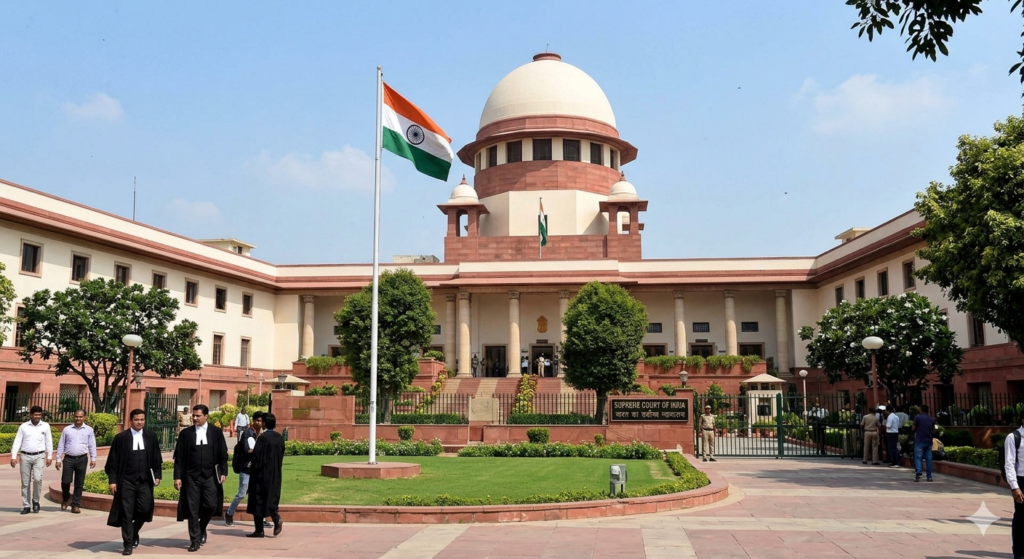
The Supreme Court of India has categorically ruled that a mere ‘wrong statement’ arising out of inadvertent typographical errors in legal pleadings cannot constitute the basis for directing criminal prosecution for perjury under Section 340 of the Code of Criminal Procedure, 1973 (CrPC). In a significant relief to legal practitioners and litigants alike, a Division Bench comprising Justice Ujjal Bhuyan and Justice Atul S. Chandurkar quashed an order directing the prosecution of a litigant and his advocate for offences punishable under Sections 193, 199, and 200 of the Indian Penal Code, 1860 (IPC).
The Court emphasized the strict legal threshold for perjury, clarifying that an inadvertent “wrong statement” without a deliberate intent to deceive does not equate to a “false statement,” and mandated that courts must explicitly record why initiating prosecution is “expedient in the interests of justice”.
Factual Background (The Matrix)
The dispute traces back to a civil suit instituted over property enjoyment rights. In 2001, the trial court granted a temporary injunction against the original defendants. Prabhakar Yeshwant Masram (Appellant No. 1) later purchased the property and was impleaded in the suit in 2003. When the plaintiffs alleged a breach of the injunction, the trial court exercised its powers under Order XXXIX Rule 2A of the Code of Civil Procedure, 1908 (CPC), ordering restoration of the site and issuing a show-cause notice to the appellant.
The appellant, represented by his counsel (Appellant No. 2), challenged this by filing a Miscellaneous Civil Appeal alongside an application for stay, which successfully resulted in the appellate court staying the trial court’s order on January 17, 2004.
However, the plaintiffs alleged that the memorandum of appeal and the stay application contained false statements—specifically, using the word “dismissed” instead of “disposed of”, and inadvertently omitting the word “no” in a sentence—which allegedly misled the appellate court. After the Bombay High Court declined to entertain a criminal contempt petition, it granted the plaintiffs liberty to file an application under Section 340 CrPC.
In 2006, the 7th Additional District Judge, Nagpur, held that a prima facie case of “wrong statements” was made out and ordered the lodging of a criminal complaint against both the appellant and his counsel. This drastic order was upheld by the High Court in 2012, prompting the present appeal before the Supreme Court.
Core Issues Framed
The Supreme Court deliberated upon the following critical questions of law:
- Whether a prima facie satisfaction that ‘wrong statements’ were made in pleadings prepared by a counsel is sufficient to invoke powers under Section 340 CrPC for offences under Sections 193, 199, and 200 IPC?
- Whether an order directing a criminal complaint is valid in the absence of a specific finding that such an inquiry is “expedient in the interests of justice”?
- Whether an appellate court can augment a lower court’s order to the detriment of the appellants by recording adverse findings (e.g., that they filed a “false affidavit”) that were entirely absent in the original order?
Arguments at a Glance
- For the Appellants: It was argued that there was absolutely no deliberate falsehood or intent to mislead the court. The errors were purely typographical mistakes made by a part-time steno-typist (e.g., typing “dismissed” instead of “disposed of”). Crucially, the appellants had proactively moved an application to correct these typographical mistakes under Order VI Rule 17 CPC on September 20, 2004—months before the respondents even filed the Section 340 CrPC application in April 2005.
- For the Respondents: Despite being served, the respondents did not enter an appearance to oppose the appeal.
Court’s Observations & Reasoning (Ratio Decidendi)
Authoring the judgment for the Bench, Justice Atul S. Chandurkar meticulously dismantled the rationale adopted by the lower courts.
1. The Statutory Distinction Between “Wrong” and “False” The Court noted that the 7th Additional District Judge had merely recorded a prima facie satisfaction that “wrong statements” were made. The Supreme Court held that the threshold for initiating action under Sections 191, 193, 199, and 200 IPC is the making of a deliberate “false statement,” not an inadvertent error.
“There is a material difference between making a ‘wrong statement’ and ‘false statement’ in the context of Sections 199 and 200 of the Penal Code. A ‘wrong statement’ of fact may not always have the character of a ‘false statement’… The threshold for initiating action… is the making of a ‘false statement’ and not the making of a ‘wrong statement’. It is so because a ‘false statement’ denotes a deliberate intention in making such statement; in other words, it is a wrongful or erroneous statement made intentionally to gain an undue advantage.”
2. The Mandatory Requirement of “Expedience in the Interest of Justice” Relying on the Constitution Bench precedent in Iqbal Singh Marwah v. Meenakshi Marwah (2005), the Court reiterated that Section 340 is conditioned by the words “Court is of opinion that it is expedient in the interest of justice.”. The lower court entirely failed to record this indispensable statutory prerequisite, rendering the order bad in law. Quoting Santokh Singh v. Izhar Hussain (1973), the Court noted that prosecutions should be ordered in the larger interest of justice, not to gratify feelings of personal vindictiveness.
3. Improper Enhancement of the Order by the High Court The Supreme Court strongly rebuked the Bombay High Court for recording a new finding that a “false affidavit” was filed, despite the trial court only observing “wrong statements”. The Court emphasized that an appellant cannot be placed in a worse position in an appeal preferred by them, especially when the plaintiffs had not cross-appealed the original order.
4. Weaponization of Section 340 as a Delay Tactic The Court noted that applications under Section 340 CrPC are frequently misused to derail substantive proceedings. Re-affirming Iqbal Singh Marwah, the Court advised that a direction to file a perjury complaint should normally wait until the final judgment is rendered in the main proceedings, to prevent the diversion of judicial time.
Conclusion & Impact
The Supreme Court allowed the appeal, comprehensively quashing the orders of the courts below, and dismissed the Section 340 CrPC application against the appellants.
Impact Analysis:
This judgment serves as a vital shield for the legal fraternity against malicious prosecution and intimidation tactics by rival litigants. By firmly distinguishing a human error—such as a stenographer’s typo in pleadings drafted by counsel—from calculated perjury (mens rea), the Court has curtailed the weaponization of perjury applications. It serves as a stern reminder to trial courts that they are not mere post offices for perjury complaints; they must act only when there is deliberate falsehood on a matter of substance, and strictly when it is “expedient in the interests of justice” to protect the broader administration of law.